

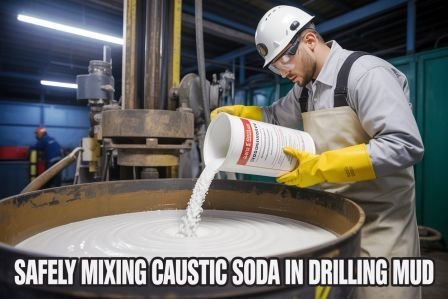
If you work on a rig or manage drilling fluid systems, you already know that keeping your mud in good shape is non-negotiable. One of the most common ways to do that is by adding caustic soda — or sodium hydroxide (NaOH) — to control drilling mud pH and keep the fluid performing the way it should. But mixing NaOH into drilling fluid isn’t something you want to wing. Done wrong, it can damage your mud properties, delay operations, or seriously hurt someone.
This guide is written for mud engineers, drilling fluid technicians, and rig hands who need a straightforward, practical walkthrough of how to mix caustic soda in mud safely and effectively.
Here’s what we’ll cover:
- Why caustic soda matters in drilling fluid treatment — what it actually does to your mud and when you need it
- Safe handling and caustic soda safety precautions for oilfield environments — the gear, the rules, and the habits that keep people safe
- How to get the caustic soda concentration right — so you’re not overtreating or underdoing it and throwing your whole system off
By the end, you’ll have a clear, step-by-step process you can actually use on the job — not just theory.
Understanding Caustic Soda and Its Role in Drilling Mud

What Caustic Soda Does to Improve Mud Performance
Caustic soda — chemically known as sodium hydroxide (NaOH) — is one of the most widely used chemical additives in drilling fluid systems. When you add it to drilling mud, it raises the pH of the fluid, which directly affects how every other component in that mud behaves. Think of it as the chemical backbone that keeps your fluid system in balance.
Here’s what caustic soda actually does inside the mud system:
- Raises and stabilizes pH: Drilling mud needs to maintain an alkaline environment, typically between pH 9.5 and 11.5, depending on the formation being drilled. Caustic soda pushes the pH into that range and keeps it there.
- Controls hydrogen sulfide (H₂S): In sour gas formations, H₂S is a serious hazard — both to personnel and to drilling equipment. A high-pH mud helps neutralize dissolved hydrogen sulfide before it can become a problem.
- Improves filtration control: When the pH is in the right range, filtration control additives like bentonite and CMC (carboxymethylcellulose) perform significantly better. Caustic soda helps unlock the full potential of those additives.
- Reduces corrosion: Low-pH mud is corrosive to drill string, casing, and surface equipment. Keeping pH elevated with NaOH drilling fluid treatment helps protect that expensive downhole hardware.
- Activates bentonite: Native clays and commercial bentonite don’t hydrate and swell properly in neutral or acidic water. Caustic soda helps them yield at their full capacity, which is critical for building the viscosity and gel strength your mud needs to carry cuttings.
- Prevents clay flocculation: Certain contaminants — especially calcium ions from cement or anhydrite formations — will cause clay particles to flocculate and drop out of suspension. Raising pH with caustic soda helps combat this effect.
Without proper caustic soda drilling mud management, your fluid system can fall apart fast, especially when drilling through reactive shales or contaminated formations.
Key Properties That Make It Essential in Drilling Operations
Sodium hydroxide isn’t just any alkaline agent. Its specific physical and chemical properties make it particularly well-suited for oilfield use. Here’s a breakdown of what sets it apart from other pH-control chemicals:
Physical and Chemical Properties of NaOH
| Property | Value / Description |
|---|---|
| Chemical formula | NaOH |
| Molecular weight | 40 g/mol |
| Physical form | White flakes, pellets, or beads |
| Solubility in water | Highly soluble (~111 g per 100 mL at 20°C) |
| pH of 1% solution | ~13 |
| Heat of dissolution | Highly exothermic (releases significant heat) |
| Reactivity | Reacts strongly with acids, CO₂, and moisture |
Why These Properties Matter in the Field
- High solubility means NaOH dissolves quickly in both fresh water and low-salinity brine systems, making it easy to work with when you need to adjust pH fast.
- Strong alkalinity means you don’t need large quantities to see a significant pH shift. A little goes a long way, which makes dosage control and caustic soda concentration in drilling critical — overshoot the target pH and you can damage mud properties just as badly as undershooting it.
- Exothermic dissolution is a double-edged sword. It speeds up hydration in some cases, but it also creates a serious burn hazard if the material contacts skin or eyes. This is why safe handling of caustic soda in the oilfield is non-negotiable.
- Reactivity with CO₂ is worth paying attention to. In formations with high carbon dioxide content, NaOH will react with dissolved CO₂ to form sodium carbonate, which can cause mud contamination if not managed properly.
- Compact, lightweight packaging — NaOH is easy to transport and store on a rig site compared to bulk liquid caustic, though liquid sodium hydroxide (typically 50% solution) is also used in some operations for more precise automated dosing.
From a drilling mud pH control standpoint, no other chemical offers the same combination of effectiveness, availability, cost-efficiency, and compatibility with existing mud chemistry.
Common Risks of Improper Caustic Soda Use
Caustic soda is powerful, and that cuts both ways. When you don’t handle it correctly or add it in the wrong amounts, the consequences range from damaged mud properties to serious injuries. These are the risks that every mud engineer and rig hand needs to understand before working with NaOH.
Risk 1: Chemical Burns and Physical Injury
NaOH is highly corrosive. Contact with skin causes severe chemical burns that may not be immediately painful — which actually makes them more dangerous because people sometimes don’t react fast enough. Eye contact can cause permanent damage within seconds. These aren’t theoretical risks; burns from caustic soda are among the most common chemical injuries in oilfield operations.
At-risk scenarios include:
- Opening bags in windy conditions without proper PPE
- Mixing NaOH into water too quickly and splashing
- Failing to wear chemical-resistant gloves, goggles, or a face shield
Risk 2: Overtreatment and Mud Degradation
Adding too much caustic soda is one of the most common mistakes on the rig floor. When the pH climbs above 12 or 13 in a water-based mud system, several things start to go wrong:
- Viscosity loss: Excessive alkalinity can cause clay dispersion and rheology breakdown, especially in KCl-polymer or low-solids mud systems.
- Polymer degradation: Many organic polymers used in drilling fluid maintenance — like PAC, PHPA, and xanthan gum — start to break down at very high pH levels.
- Flocculation of certain additives: Some materials behave poorly at extreme pH values, leading to inconsistent mud performance.
Risk 3: Undertreatment in Contaminated Mud
Not adding enough NaOH is just as problematic. If your mud pH drops below 9, you’re looking at:
- Increased risk of H₂S breakthrough
- Poor shale inhibition
- Faster corrosion of downhole tools and surface equipment
- Poor bentonite yield and reduced filtration control
Risk 4: Improper Mixing Sequence
A critical — and often overlooked — hazard is how NaOH is added to water. You always add caustic soda to water, never the other way around. Adding water to solid NaOH causes a violent exothermic reaction that can splash boiling caustic liquid in all directions. This applies whether you’re mixing in a bucket, a mud hopper, or a chemical barrel.
Risk 5: Storage and Handling Failures
Caustic soda is hygroscopic, meaning it absorbs moisture from the air. If bags are left open or improperly sealed:
- The material clumps and becomes difficult to handle
- Moisture absorption generates heat, creating a localized hazard
- Degraded product may not dissolve evenly, leading to inconsistent pH treatment
Proper storage in sealed, dry, clearly labeled containers is a basic requirement that sometimes gets skipped under the pressure of daily rig operations — and that’s when incidents happen.
Summary of Key Risks at a Glance
| Risk Category | Potential Consequence |
|---|---|
| Skin/eye contact | Chemical burns, permanent eye damage |
| Overtreatment (high pH) | Mud degradation, polymer breakdown |
| Undertreatment (low pH) | H₂S hazard, corrosion, poor mud performance |
| Wrong mixing sequence | Violent exothermic reaction, splash burns |
| Improper storage | Clumping, inconsistent dosing, heat generation |
Understanding these risks upfront is what separates a well-run mud program from one that creates problems — for the well, the equipment, and the people working on the rig.
Essential Safety Gear and Precautions Before You Begin

Protective Equipment Every Driller Must Wear
Caustic soda (sodium hydroxide / NaOH) is one of the most aggressive chemicals you’ll handle on a drilling site. It causes severe chemical burns on contact with skin, can permanently damage your eyes within seconds, and releases heat when dissolved in water. Safe handling caustic soda in oilfield environments starts with wearing the right gear — every single time, without shortcuts.
Here’s what you need on your body before you even open the bag:
- Chemical-resistant gloves – Thick neoprene or nitrile gloves rated for alkali exposure. Thin latex gloves won’t cut it. NaOH will eat right through them.
- Full-face shield or chemical splash goggles – Safety glasses alone are not enough. A face shield covering your nose, mouth, and chin is the minimum standard when mixing sodium hydroxide into drilling fluid.
- Chemical-resistant apron or coveralls – A waterproof apron made from polyethylene or a full chemical-resistant suit prevents NaOH splashes from soaking through your clothes to your skin.
- Steel-toed, chemical-resistant boots – Avoid leather. NaOH can saturate leather and hold contact with your skin long after the initial splash.
- Respirator (as needed) – When mixing in enclosed spaces or dealing with caustic dust from dry NaOH pellets or flakes, wear a dust mask rated at minimum N95, or a half-face respirator with P100 filters.
| PPE Item | Minimum Rating | Why It Matters |
|---|---|---|
| Gloves | Neoprene/Nitrile, alkali-rated | Prevents severe hand burns |
| Eye Protection | Full-face chemical splash shield | NaOH can cause permanent eye damage in seconds |
| Body Protection | Chemical-resistant apron or coveralls | Stops skin exposure from splash or spill |
| Footwear | Chemical-resistant, steel-toed boots | Protects feet from spills and heavy containers |
| Respiratory | N95 or P100 respirator | Guards against inhaling caustic dust |
Never assume that because you’ve done this a hundred times, you can skip a piece of PPE. The one time you do, the bag tears or the bucket tips.
Setting Up a Safe Mixing Environment
Where you mix caustic soda into your drilling mud matters just as much as how you mix it. A well-organized, hazard-aware mixing area dramatically lowers the risk of accidents.
Choose the right location:
- Mix outdoors or in a well-ventilated area whenever possible. Dissolving NaOH in water releases heat and can produce steam. Enclosed spaces trap that steam and increase inhalation exposure.
- Keep the mixing zone away from high-traffic areas on the rig floor. Foot traffic near an active NaOH mixing station is an accident waiting to happen.
- Work on a stable, flat surface. Spills on uneven ground spread fast and create a much larger contamination zone.
Control who enters:
- Mark the mixing area clearly with hazard tape or cones.
- Only personnel directly involved in the mixing process should be inside the zone.
- Post a chemical hazard sign identifying NaOH (caustic soda) and the associated risks.
Prepare your mixing equipment:
- Use dedicated, labeled chemical-resistant mixing buckets or tubs. Never reuse containers that held food, diesel, or other chemicals.
- Have a slow-stir paddle or mechanical agitator available. Pouring NaOH into water and then hand-stirring rapidly causes dangerous splashing.
- Always add caustic soda TO the water, never pour water onto a pile of dry NaOH. Adding water to NaOH causes a violent exothermic reaction that can boil, steam, and spatter the solution onto your skin and eyes.
Designate a clean water source nearby:
- A water hose or emergency eyewash station should be within 10 seconds of walking distance from the mixing zone, no exceptions. When you’re dealing with caustic soda drilling mud operations, seconds matter after a splash.
Emergency Procedures to Have in Place
Before you mix a single gram of NaOH into your drilling fluid, you need clear emergency procedures ready — not written somewhere in a binder back at the office, but known by everyone on site and physically prepared at the work area.
Eye or skin contact — act immediately:
- Flush affected skin or eyes with large volumes of clean water for a minimum of 15–20 minutes continuously.
- Remove contaminated clothing while flushing.
- Do not attempt to neutralize caustic soda burns with vinegar or acid on skin — this causes additional chemical reactions and worsens the injury.
- After flushing, seek medical attention immediately, even if the burn seems minor. NaOH burns are deceptively deep.
Spill response:
- Small spills on hard surfaces: Neutralize carefully with diluted weak acid (like dilute citric acid or vinegar), then absorb with dry sand or absorbent pads. Avoid creating a runoff path toward drains.
- Large spills: Evacuate the immediate area, contain the spill with berms or absorbent booms, and follow your site’s chemical spill response plan.
- Never wash large NaOH spills into drains or water bodies. Sodium hydroxide drilling fluid treatment chemicals are regulated waste in many jurisdictions.
What to have physically staged at the mixing area:
- Eyewash station or portable eyewash bottle (minimum 1 liter)
- Emergency water hose or large clean water bucket
- First aid kit with burn dressing materials
- Printed SDS (Safety Data Sheet) for sodium hydroxide
- Site emergency contact numbers posted visibly
- Spill kit (absorbent pads, neutralizing agent, PPE for cleanup)
Communication protocol:
- Make sure at least two people are present during any caustic soda drilling mud mixing operation. Never mix NaOH alone.
- The second person acts as a safety observer and is responsible for activating site emergency response if needed.
Poor storage of NaOH on a drilling site is a slow-moving hazard. Caustic soda is hygroscopic — it actively absorbs moisture from the air, which causes it to clump, degrade, and can even cause bags to burst or weaken over time. On top of that, it reacts with aluminum, zinc, and certain alloys, so storage area selection actually matters.
Storage location requirements:
Store NaOH in a cool, dry, well-ventilated area away from direct sunlight and moisture.
- Keep it away from acids, ammonium compounds, and flammable materials. NaOH in contact with certain metals generates hydrogen gas, which is a fire and explosion hazard.
- Elevate bags off the ground on wooden pallets to prevent moisture absorption from concrete floors.
- The storage area should have a secondary containment system (a bunded area or spill lip) to contain any leaks or spills.
Container and packaging rules:
- Keep NaOH in its original labeled containers for as long as possible.
- If transferring to a site storage bin or container, use only HDPE (high-density polyethylene) or polypropylene containers rated for strong alkalis. Never store in metal bins.
- Reseal opened bags tightly after every use using clips or by folding the bag over securely. Exposed NaOH pellets or flakes will absorb humidity, clump, and lose their effectiveness for drilling mud pH control.
Labeling and inventory:
- Every container must be clearly labeled with: chemical name (Sodium Hydroxide / Caustic Soda), concentration or form (e.g., dry flakes, 50% solution), hazard warnings, and date received.
- Operate on a first-in, first-out (FIFO) inventory system so older stock gets used before newer bags.
- Keep the SDS for NaOH on file at the chemical storage location and at the rig’s safety station.
Quantity limits:
- Only bring to the rig site what you reasonably need for the current section of the well. Excess caustic soda sitting around increases storage risk with no operational benefit.
- Conduct a weekly visual inspection of storage bags for signs of moisture damage, leaking, or swelling.
Determining the Right Caustic Soda Concentration for Your Mud

How to Test Current Mud pH Levels Accurately
Before you even think about adding caustic soda to your drilling mud, you need to know exactly where your pH stands. Guessing is not an option when you’re dealing with NaOH drilling fluid treatment — a small miscalculation can send your mud chemistry in the wrong direction fast.
Tools You’ll Need for pH Testing
- Calibrated pH meter — This is your most reliable option. Digital meters give you a precise reading down to one or two decimal places, which matters a lot when you’re targeting a specific pH window.
- pH test strips — These work fine for quick field checks, but they’re not as accurate as a meter. Use them as a rough guide, not a final answer.
- Titration kits (P1, P2, MF alkalinity tests) — These are the gold standard in drilling fluid maintenance. The P1 and P2 alkalinity tests measure phenolphthalein alkalinity of the filtrate and whole mud, giving you a much clearer picture of hydroxyl ion concentration than pH alone.
Step-by-Step pH Testing Process
- Pull a representative sample from the active mud pit — don’t test from a stagnant corner of the system.
- Allow the sample to cool to room temperature if it’s been circulating. Heat affects your readings.
- Rinse your pH meter electrode with distilled water before use.
- Calibrate the meter using standard buffer solutions (pH 7 and pH 10 are typically used for drilling mud ranges).
- Submerge the electrode in the mud sample and wait for the reading to stabilize — don’t rush this.
- Record the reading. For water-based drilling muds, a pH between 9.5 and 11.5 is typically the target range, depending on the application.
- Run the P1 alkalinity titration on the filtrate for a more complete alkalinity profile.
> Quick Tip: Always test pH at multiple points in the mud system — suction pit, active pit, and shale shaker return. Variations across the system tell you a lot about where your chemistry is drifting.
Calculating the Correct Amount of Caustic Soda to Add
Getting the caustic soda concentration right in your drilling mud is part chemistry, part field experience. The goal is to raise pH to the desired level without overshooting it. Sodium hydroxide (NaOH) is highly reactive, and adding too much will push your mud into a highly alkaline state that can damage formations, corrode equipment, and make the mud difficult to control.
Understanding the Relationship Between NaOH and pH
pH is a logarithmic scale. Moving from pH 9 to pH 10 is not the same effort as moving from pH 10 to pH 11. Each full unit increase requires roughly 10 times more caustic soda. This is why it pays to be precise when you’re working near the top of your target range.
Basic Calculation Method
The most common field approach is based on pounds per barrel (ppb) or kilograms per cubic meter (kg/m³) additions, tied to your current and target P1 alkalinity values.
Here’s a simplified working formula used in the field:
NaOH Required (ppb) = (Target P1 – Current P1) × Mud Volume Factor
A rule of thumb many drillers use:
- 0.1 lb/bbl (0.28 kg/m³) of NaOH raises the filtrate P1 alkalinity by approximately 0.1 cm³ in a standard titration.
For direct pH adjustment in fresh water-based mud:
| Current pH | Target pH | Approximate NaOH Addition |
|---|---|---|
| 8.5 | 9.5 | 0.05 – 0.10 lb/bbl |
| 9.0 | 10.0 | 0.10 – 0.20 lb/bbl |
| 9.5 | 11.0 | 0.25 – 0.50 lb/bbl |
| 10.0 | 11.5 | 0.50 – 1.00 lb/bbl |
> Important: These are starting-point estimates. Always add caustic soda in small increments, test after each addition, and let the system circulate for at least one full cycle before re-testing.
Factors That Affect Your Calculation
- Mud volume — More mud means more NaOH needed. Always know your active system volume before calculating.
- Contaminants — CO₂, H₂S, and carbonates consume alkalinity and may require more NaOH than the baseline calculation suggests.
- Hardness of mix water — Hard water with high calcium content will buffer the pH and reduce NaOH effectiveness. A water softening pre-treatment may be needed.
- Lignosulfonate or polymer content — Some mud additives are pH-sensitive and can absorb hydroxyl ions, increasing your NaOH demand.
Always document your additions carefully. Maintaining a treatment log helps you spot trends and predict future caustic soda requirements as you drill deeper.
Adjusting Concentration Based on Formation Type
Not all formations behave the same way when your mud chemistry changes, and your caustic soda concentration targets need to reflect what you’re drilling through.
Shale Formations
Shales are arguably the most pH-sensitive formations you’ll encounter. Reactive shales, especially those with high clay content, respond strongly to changes in mud alkalinity.
- A higher pH range (10.0 – 11.0) helps inhibit clay hydration and swelling.
- Too much NaOH, however, can break down filtration control additives and cause the mud to thin excessively.
- When drilling through gumbo shales or dispersive clays, you’ll typically want to pair NaOH treatment with potassium chloride (KCl) or other inhibitors to get the full inhibition effect.
Carbonate and Limestone Formations
Carbonates can introduce CO₂ into the mud system, which reacts with NaOH to form sodium carbonate (Na₂CO₃) and sodium bicarbonate (NaHCO₃). This “bicarbonate contamination” eats through your alkalinity fast.
- You’ll likely need more frequent pH checks and higher NaOH additions when drilling through carbonates.
- Watch your P2 alkalinity readings — a drop in P2 relative to P1 is a sign of carbonate influx.
- Calcium hydroxide (lime) is sometimes used alongside NaOH in these situations to counteract bicarbonate contamination more effectively.
Salt Formations and Halite Sections
Salt sections require a different approach altogether:
- High chloride levels from dissolved salt can interfere with pH electrode readings — always confirm with titration in salty muds.
- Saturated salt muds typically operate at lower pH targets (9.0 – 10.0) to maintain viscosity and filtration control.
- Excess NaOH in salt muds can cause viscosity spikes and increase your equivalent circulating density (ECD), which creates downhole pressure problems.
Sandstone and Tight Gas Formations
Sandstones are generally less reactive than shales, giving you a bit more flexibility. Still, if you’re drilling through fine-grained sandstones:
- Keep pH in the 9.5 – 10.5 range to protect clay-bound minerals within the sand matrix.
- Overly high pH can damage acid-soluble cements between sand grains, increasing the risk of formation damage near the wellbore.
Formation-Based pH Target Summary
| Formation Type | Recommended pH Range | Notes |
|---|---|---|
| Reactive Shale | 10.0 – 11.0 | Pair with KCl or other inhibitors |
| Limestone / Carbonate | 9.5 – 11.0 | Monitor for bicarbonate contamination closely |
| Salt / Halite | 9.0 – 10.0 | Use titration to confirm — avoid electrode only |
| Sandstone | 9.5 – 10.5 | Watch for formation damage at high pH |
| Mixed Lithology | 9.5 – 10.5 | Adjust incrementally as lithology changes |
Staying in tune with your formation type as you drill deeper is one of the best drilling fluid maintenance habits you can build. Real-time lithology logging, mud log reports, and good communication between your mud engineer and geologist will help you stay ahead of pH swings before they become a problem.
Step-by-Step Process for Safely Mixing Caustic Soda into Drilling Mud

Preparing Your Mud System Before Adding Caustic Soda
Before you even open a bag of caustic soda (NaOH), your mud system needs to be in the right condition. Skipping this prep step is one of the most common reasons mixing goes sideways.
Check your current mud properties first:
- Measure the baseline pH using a calibrated pH meter or pH strips — you want to know exactly where you’re starting from
- Record current mud weight (density) using a mud balance
- Check the Marsh Funnel viscosity to understand the current rheological state
- Confirm your mud volume in the active system so you can calculate the correct caustic soda dosage accurately
Get your mud circulating before you add anything. Your centrifugal pump or mud agitator should be running at full capacity. A stagnant mud system will cause hot spots where caustic soda concentrates and reacts unevenly. Good circulation ensures the chemical disperses throughout the whole system rather than sitting in one place and creating localized high-pH zones that can damage your mud’s colloidal structure.
Pre-check your equipment:
- Inspect the mixing hopper or chemical barrel for residue from previous chemicals — especially acids or calcium-based products
- Make sure your suction and discharge lines are clear
- Confirm that your flow rate through the hopper is consistent
Temperature matters here too. If your mud is already running hot (above 150°F or 65°C), caustic soda additions will generate additional heat due to its highly exothermic dissolution. In hot conditions, reduce your addition rate and monitor closely.
The Correct Order of Adding Chemicals to Avoid Reactions
Order of addition is not just a suggestion in drilling fluid chemistry — it’s a rule that prevents expensive and sometimes dangerous chemical incompatibilities.
General rule: Caustic soda should almost always go in before other mud treatment chemicals like lignosulfonate, lignite, or PAC polymers — but after water and base fluid are established in the system.
Here’s a practical sequencing guide:
| Step | Action | Why It Matters |
|---|---|---|
| 1 | Circulate base mud thoroughly | Ensures uniform starting condition |
| 2 | Add caustic soda (NaOH) | Adjusts pH before other chemicals are sensitive to it |
| 3 | Wait for full circulation (at least one complete cycle) | Lets pH stabilize before adding other products |
| 4 | Add lignosulfonates or thinners | These work best in a controlled pH environment (typically 9.5–10.5) |
| 5 | Add fluid loss control agents (e.g., CMC, PAC) | Polymers hydrate more effectively at the correct pH |
| 6 | Add weighting material (barite) if needed | Goes in last to avoid interfering with chemical hydration |
What NOT to mix caustic soda with directly:
- Calcium chloride or calcium-based additives — combining these can cause instant precipitation and wreck your fluid loss control
- Acids or acidic pH adjusters — obviously a dangerous exothermic reaction
- Gypsum-treated muds without modification — caustic in a gyp system needs very careful dosing or you risk destabilizing the calcium balance
Always let the mud complete at least one full circulation cycle between chemical additions. This gives each chemical time to do its job and gives you accurate readings before you add the next product.
Controlling Mixing Speed and Temperature for Best Results
The physical mechanics of how you add caustic soda matter just as much as the chemistry. Two variables you need to stay on top of are mixing speed and temperature — both directly affect how well NaOH disperses and how safely the process goes.
Mixing Speed
- Use your jet hopper at a moderate, consistent flow rate. Don’t dump large quantities in all at once.
- A good rule of thumb is adding caustic soda slowly in incremental batches — typically 25–50 lb (11–22 kg) additions with at least 15 minutes of circulation between each batch in larger active systems
- Too fast an addition rate leads to localized high-pH zones that can flocculate clays or degrade polymer-based mud additives before they have a chance to work properly
- If you’re using a batch mixing tank, keep the agitator running at high speed throughout the entire addition process
Temperature Control
Caustic soda dissolves in water through an exothermic reaction, meaning it releases heat. The hotter your mud already is, the more you need to slow things down.
| Starting Mud Temperature | Recommended Caustic Addition Rate |
|---|---|
| Below 100°F (38°C) | Normal rate — standard incremental additions |
| 100°F – 140°F (38°C – 60°C) | Reduce batch size by 25–30%, increase wait time |
| Above 140°F (60°C) | Small additions only, with extended circulation time between batches |
Watch the mud temperature at the shale shaker return line — this gives you a real-time reading of what’s coming back from the well. If you see a temperature spike during mixing, stop additions immediately and circulate until temperature stabilizes before continuing.
In very hot environments (deep wells, high geothermal gradient), pre-dissolving caustic soda in a small volume of water in a separate container before adding it to the hopper can help manage the heat load on the active system.
Monitoring Mud Properties Throughout the Mixing Process
You can’t just add caustic soda and walk away. Active monitoring throughout the process is what separates a clean, controlled mud treatment from a messy correction job that costs hours of rig time.
Properties to check at each circulation cycle during mixing:
- pH — Your primary indicator. For most water-based drilling muds, the target range is 9.5 to 10.5. Check it after every major batch addition.
- Funnel viscosity — Watch for sudden viscosity spikes. A sharp increase can mean the pH has gone too high and is causing clay flocculation.
- Plastic viscosity (PV) and yield point (YP) — Run a full API rheology test if you see unexpected viscosity changes. PV and YP shifts tell you how the clay and polymer system is responding.
- Filtrate/fluid loss — Check API fluid loss if time allows. Caustic soda affects filter cake quality, and you want to make sure your fluid loss control hasn’t been disrupted.
- Mud weight — Caustic soda has minimal effect on mud weight, but it’s good practice to record it during treatment to catch any unintended dilution.
Keep a mud log sheet going in real time. Record every addition, the time it was made, volume added, and the mud properties measured after that cycle. This gives you a clear paper trail and makes it easy to troubleshoot if something goes wrong.
Warning signs to watch for:
- pH climbing above 11 — slow down or stop additions immediately
- Sudden viscosity increase — circulation may not be sufficient, or overdose is occurring
- Gelation of the mud — could signal chemical incompatibility or excessive NaOH concentration
- Foam at the surface — sometimes an indicator of rapid gas generation or incompatible product interaction
Verifying Final pH and Mud Weight After Mixing
Once you’ve finished adding caustic soda and the mud has completed at least two full circulation cycles, it’s time to verify that everything came out where you wanted it.
Final pH Verification
pH is the core measurement that tells you whether your caustic soda treatment worked as intended.
How to measure accurately:
- Pull a clean sample directly from the flowline return — not from a stagnant pit corner
- Allow the sample to cool slightly if it’s very hot (above 120°F), since elevated temperature can give artificially high pH readings with some electrodes
- Use a calibrated digital pH meter — pH strips are acceptable for a quick field check, but a meter gives you precision to one decimal place, which matters when you’re targeting a narrow window like 9.5–10.5
- Run two separate readings and average them for reliability
What to do if pH is off-target:
| Result | Action |
|---|---|
| pH below target (e.g., below 9.5) | Add another small batch of caustic soda, circulate, re-test |
| pH at target (9.5–10.5) | No further caustic addition needed — proceed to next treatment step |
| pH above target (above 10.5) | Stop additions, circulate, allow time for system to buffer; consider controlled dilution |
| pH above 11.5 | Serious overdose — consider diluting with fresh water and check all other mud properties before continuing operations |
Final Mud Weight Check
Run a mud balance test on your flowline sample right after pH verification.
- For unweighted muds, caustic soda treatment alone shouldn’t change mud weight significantly (NaOH additions are typically small relative to total mud volume)
- For weighted muds (barite or hematite systems), confirm the mud weight is within ±0.1 ppg of your target — any significant deviation suggests dilution or an unplanned volume addition occurred during mixing
Additional Properties to Confirm Before Resuming Drilling
| Property | Acceptable Range (Typical WBM) | Test Method |
|---|---|---|
| pH | 9.5 – 10.5 | Digital pH meter |
| Funnel Viscosity | Per well program spec | Marsh Funnel |
| Plastic Viscosity | Per well program spec | Rheometer/viscometer |
| Yield Point | Per well program spec | Rheometer/viscometer |
| API Fluid Loss | < 15 mL/30 min (or per program) | API Filter Press |
| Mud Weight | Per well program spec ±0.1 ppg | Mud balance |
Document every final reading in your drilling fluid report before calling the treatment complete. The mud engineer or company man should sign off on the final properties before drilling resumes. This isn’t just good practice — on most rigs it’s a contractual requirement, and it protects you if any wellbore problems show up later that could be linked to mud condition.
Troubleshooting Common Mixing Problems and How to Fix Them

Identifying Signs of Over-Treatment with Caustic Soda
Over-treating your drilling mud with caustic soda (NaOH) is one of the most common mistakes on the rig, and catching it early saves you a lot of headache. When pH climbs above 11.5–12, you’re in over-treatment territory, and the mud will start telling you loud and clear.
Watch for these warning signs:
- Sudden viscosity spike – The mud thickens up faster than expected and becomes harder to pump. High pH accelerates clay hydration, and bentonite particles swell aggressively, making the whole system gel up.
- High gel strengths that won’t break – Progressive gels that keep climbing even after circulation suggest the pH has pushed clay chemistry into overdrive.
- Excessive foaming at the surface – Over-alkaline mud tends to trap air and foam, especially when organic materials are present in the fluid.
- Slick, slippery feel on pit surfaces – Caustic soda converts natural fats and oils into soap-like compounds. If your pit walls feel greasy or foamy, that’s a red flag.
- pH reading above 12 on your Garret Gas Train or strip tests – Always cross-check with a calibrated pH meter. Strip tests can lose accuracy at very high pH ranges.
- Drastic drop in filtration control – Paradoxically, heavy over-treatment can actually degrade filter cake quality by destabilizing the clay structure.
Quick diagnostic checklist:
| Symptom | Likely pH Range | Urgency |
|---|---|---|
| Mild viscosity increase | 10.5 – 11.5 | Monitor closely |
| Foaming + gel spikes | 11.5 – 12.0 | Begin corrective action |
| Pumpability issues | 12.0 – 12.5 | Immediate correction needed |
| Severe gelation, equipment strain | Above 12.5 | Stop treatment, dilute ASAP |
Don’t wait until you see multiple symptoms stacking up. One early sign is enough to pause caustic soda additions and re-test your mud before continuing.
How to Correct pH Imbalances Without Wasting Mud
Correcting a pH imbalance in drilling mud — whether too high or too low — doesn’t mean dumping the whole pit and starting fresh. In most cases, targeted chemical adjustments get your drilling fluid back in shape without wasting expensive materials.
Bringing pH Down (Over-Alkaline Mud)
If your caustic soda drilling mud has gone above the target pH range (usually 9.5–10.5 for most freshwater systems), here’s how to bring it back:
1. Use CO₂ or Sodium Bicarbonate (NaHCO₃)
Sodium bicarbonate is the go-to acid neutralizer in drilling fluid treatment. It reacts with excess hydroxide to form water and carbonate, dropping the pH gently without shocking the system.
- Add sodium bicarbonate in small, measured increments (0.25–0.5 lb/bbl at a time)
- Mix thoroughly and circulate before re-testing
- Avoid dumping large amounts at once — overcorrection in the opposite direction is just as bad
2. Dilution with Fresh Water
If the pH is severely elevated (above 12), diluting the active system with fresh water while circulating is often the fastest and safest first step before chemical treatment. This buys you time without adding more reactive chemistry to an already unstable system.
3. CO₂ Gas Injection (for advanced operations)
Some operations inject CO₂ directly into the mud pits to lower pH. CO₂ dissolves into water forming carbonic acid, which neutralizes excess alkalinity. This is precise but requires proper equipment and monitoring — not something to improvise in the field.
Raising pH (Under-Alkaline Mud)
Steps to raise pH safely:
- Pre-dissolve caustic soda in a separate mixing bucket using cold water (never hot) — always add NaOH to water, not water to NaOH
- Add the solution to the active system gradually at the hopper or chemical barrel
- Circulate for at least one full bottoms-up before re-testing
- Target incremental additions of 0.1–0.25 lb/bbl and recheck
Correction Rate Reference Table:
| pH Problem | Recommended Treatment | Dosage Starting Point |
|---|---|---|
| pH too high (11.5–12) | Sodium bicarbonate | 0.25 lb/bbl, incremental |
| pH too high (>12) | Dilution + bicarbonate | Dilute 10–15%, then treat |
| pH too low (<9.0) | Caustic soda (NaOH) solution | 0.1–0.25 lb/bbl, incremental |
| pH too low (<8.5) | Caustic soda + lime blend | Per mud engineer’s recommendation |
The golden rule here is test, treat, circulate, test again. Never make a second chemical addition until you’ve circulated and re-tested to see where the first addition landed. Chasing pH by dumping chemicals in sequence without testing between rounds is the fastest way to turn a manageable problem into a costly one.
Even when you follow the mixing process by the book, unexpected chemical reactions can still happen. High-temperature wells, contaminated water sources, unusual formation chemistry, and even impure NaOH batches can all throw surprises at you. Knowing how to respond quickly keeps people safe and the job moving.
1. Violent Heat Generation
Caustic soda dissolving in water is always exothermic — it releases heat. But when large amounts dissolve too quickly, or if hot water is accidentally used, the heat release can be sudden and intense. This can cause:
- Spattering of hot, corrosive liquid
- Steam generation in enclosed areas
- Cracking or warping of plastic mixing containers
What to do: Stop adding NaOH immediately. Move personnel away from the mixing area. Never try to cool the container with cold water poured directly into the hot caustic mix — thermal shock can crack containers and splash corrosive fluid. Let it cool naturally in a ventilated space.
2. Precipitation of Solids (Calcium/Magnesium Contamination)
If your mix water contains significant calcium or magnesium (hard water), adding caustic soda can trigger rapid precipitation of calcium hydroxide or magnesium hydroxide. You’ll see white, chalky solids forming almost immediately — the mud turns cloudy and viscosity spikes.
What to do:
- Stop NaOH additions
- Test water hardness before mixing next time (use a simple water hardness test kit)
- Treat the water with soda ash (Na₂CO₃) before adding caustic soda to precipitate calcium ions out of solution first
- For the current batch, check if the precipitate is causing functional problems before deciding to discard or treat further
3. Hydrogen Gas Generation
This one’s rare but serious. In certain conditions — particularly when caustic soda contacts aluminum components, aluminum tanks, or aluminum mixing tools — sodium hydroxide reacts with aluminum metal and produces hydrogen gas. Hydrogen is flammable and can accumulate in confined spaces.
What to do:
- Never store or mix caustic soda in aluminum containers
- If you smell a chemical odor combined with visible gas bubbling during mixing, evacuate the area immediately
- Ventilate the space before re-entry
- Identify and remove the aluminum contact source before resuming work
4. Incompatibility with Other Mud Additives
NaOH is a strong base and can react aggressively with:
- Acids or acid-based additives – Produces heat and can be violent in concentrated form
- Certain polymers (like PHPA) – High pH can degrade polymer chains, ruining viscosity control
- Lignosulfonate thinners – These require a pH window to function; too high a pH destroys their effectiveness
Prevention checklist:
- Always check the chemical compatibility chart for your specific mud system before adding NaOH
- Communicate with the mud engineer when the well is transitioning between mud types
- Never mix chemicals in the same container unless the procedure specifically calls for it
- Keep a chemical SDS (Safety Data Sheet) readily accessible at the mixing area
Emergency Response Quick Reference
| Situation | Immediate Action |
|---|---|
| Caustic splash on skin | Flush with large amounts of water for 15–20 minutes |
| Caustic in eyes | Eyewash station immediately, 20 minutes continuous flushing |
| Violent heat/steam from mixing container | Back away, do not add water, ventilate area |
| Gas generation suspected | Evacuate, ventilate, identify source |
| Precipitation causing thick mud | Stop additions, test water, consult mud engineer |
| Accidental ingestion | Call poison control immediately, do not induce vomiting |
Always keep your eyewash stations charged, your PPE on, and your SDS sheets within arm’s reach when working with sodium hydroxide in any drilling fluid treatment application. The reaction that catches people off guard is almost always the one nobody expected — so being prepared for the unexpected is the whole game.
Best Practices for Maintaining Mud Quality After Treatment

Routine Testing Schedules to Keep Mud in Optimal Condition
Once you’ve treated your drilling mud with caustic soda, the work doesn’t stop there. Mud conditions change constantly downhole — temperature shifts, formation fluids intrude, and solids build up — all of which can knock your pH and rheology out of range faster than you’d expect. Sticking to a solid testing schedule is what keeps small problems from turning into costly ones.
Here’s a practical testing schedule most experienced mud engineers swear by:
| Test Frequency | Parameters to Check |
|---|---|
| Every 2–4 hours (active drilling) | pH, mud weight (density), viscosity (Marsh funnel) |
| Every shift (8–12 hours) | Plastic viscosity, yield point, gel strengths, filtration (API LPLT) |
| Daily | MBT (methylene blue test), chloride content, alkalinity (Pf, Pm, Mf) |
| Weekly or as needed | Full retort analysis, calcium/magnesium content, high-temperature filtration (HPHT) |
Key Parameters to Watch After Caustic Soda Treatment
- pH: Your target range after NaOH treatment is typically 9.5–10.5 for most water-based drilling fluids. Anything above 11.5 can start degrading drill string connections and causing clay dispersion issues.
- Pf (filtrate alkalinity) and Pm (mud alkalinity): These tell you how much excess hydroxyl ion and carbonate content is sitting in your mud. They’re your early warning system for over-treatment.
- Yield point and gel strengths: Caustic soda affects clay platelet chemistry. If you overdosed, you’ll often see a spike in yield point that shows up within hours.
- Mud weight: Solids control efficiency can drop if mud chemistry goes off, so keep an eye on density trending upward unexpectedly.
Don’t wait for a problem to be obvious before you test. By the time your driller is reporting high pump pressure or a stuck pipe situation, the mud has already been out of spec for a while. Early, frequent testing is what gives you the time to make small corrections instead of big ones.
Logging Treatment Data to Improve Future Mixing Accuracy
Every time you add caustic soda to your drilling mud — whether it’s a maintenance dose or a corrective treatment — write it down. This sounds obvious, but on busy rigs, treatment logs get skipped or half-filled in. That gap in data costs you money and efficiency down the road.
A good treatment log doesn’t have to be complicated. Here’s what you want to capture every single time:
What to Include in Your Treatment Log
- Date and time of treatment
- Mud volume in the active system at the time of treatment
- Pre-treatment pH, Pf, Pm, and viscosity readings
- Amount of caustic soda added (in pounds or kilograms, and concentration of any pre-mixed solution)
- Mixing method used (slug tank, batch mixing, direct addition)
- Circulation time before re-testing
- Post-treatment pH, Pf, Pm, and viscosity readings
- Name of the mud engineer or technician who performed the treatment
- Any observations (unusual foaming, color change, viscosity spike, filtration issues)
Why This Data Is Worth Its Weight in Gold
When you’re drilling a new well in the same formation or field, you can pull up historical treatment logs and immediately see:
- How much NaOH per 100 barrels was needed to bring pH from X to Y in this specific formation
- How quickly pH dropped after treatment (which tells you how aggressive the formation water contamination is)
- Whether previous over-treatment caused rheology issues, and what correction was applied
This takes the guesswork out of caustic soda concentration in drilling operations. Instead of starting from scratch every time, you’re building a reference library that makes each subsequent well cheaper and safer to drill.
Using Digital Tools vs. Paper Logs
Both work, but digital logs tied to your mud reporting software are searchable and shareable across the rig team. If you’re still on paper, at minimum scan or photograph your daily mud reports and store them in a shared folder. Losing that data when a crew rotates out is a real problem on many rigs.
Some operators now integrate treatment data into their well planning software so that engineers can model expected caustic soda demand before the bit even hits the ground. That kind of drilling fluid maintenance approach cuts downtime and reduces chemical waste significantly.
When to Discard Treated Mud and Start Fresh
There’s a point where no amount of caustic soda treatment — or any other chemical additive — will bring your drilling mud back to where it needs to be. Knowing when you’ve crossed that line saves you from chasing a mud system that’s already too far gone.
Signs Your Mud System Is Beyond Saving
- Excessive solids content: When your retort analysis shows total solids creeping above your target ceiling and your solids control equipment is already maxed out, dilution alone won’t fix it. High-gravity solids that have been ground ultrafine by bit action become nearly impossible to remove mechanically and will continue degrading your rheology regardless of chemical treatment.
- Severe contamination: If you’ve taken a significant saltwater flow, a cement contamination event, or massive CO₂ or H₂S influx, the ionic balance of your mud can be so disrupted that rebuilding from scratch is faster and cheaper than corrective treatment.
- Irreversible rheology breakdown: Some mud systems — particularly those relying on specific clay types — lose their structural integrity after heavy caustic soda dosing or extended high-temperature exposure. If your yield point and gel strengths won’t respond normally to standard treatment, that’s a red flag.
- Uncontrollable filtration: If API filtrate and HPHT filtration numbers keep climbing despite fresh chemical additions and pH adjustments, your mud’s colloidal structure is likely degraded past the point of easy recovery.
- Cost-benefit tipping point: Sometimes the math is simple. If a fresh batch of drilling mud costs less than the chemical inventory needed to rehabilitate a sick system — plus the rig time burned chasing it — starting over is the smarter call.
How to Make the Decision Objectively
Don’t make the discard decision based on gut feeling alone. Use a simple decision framework:
| Condition | Action |
|---|---|
| pH recoverable, solids within range, rheology stable | Continue treatment and monitoring |
| pH unstable, solids elevated but manageable, rheology drifting | Dilute and treat; increase testing frequency |
| Multiple parameters out of spec simultaneously | Partial dump and rebuild with fresh base fluid |
| Contamination event (cement, salt, influx) or uncontrollable solids | Full mud dump; start fresh system |
Disposal Considerations
Treated drilling mud — especially mud that’s been dosed with sodium hydroxide (NaOH) — carries a high pH that makes improper disposal a serious environmental and regulatory concern. Before you dump, check your location-specific waste management requirements. Most jurisdictions require pH neutralization before discharge, and some require third-party disposal entirely. Keep your waste manifests and disposal records just as carefully as your treatment logs.
A fresh mud system, built correctly from the start, will almost always outperform a patched-up one. Knowing when to let go of a treated system is as important as knowing how to treat it in the first place.
References and Resources

Industry Standards and Technical Publications
When working with caustic soda in drilling mud, having the right references at your fingertips makes a real difference — especially when something unexpected happens on the job. These resources cover everything from NaOH drilling fluid treatment protocols to caustic soda safety precautions in drilling operations.
API and Industry Standards
- API Recommended Practice 13B-1 – Recommended Practice for Field Testing Water-Based Drilling Fluids — This is the go-to guide for testing and treating water-based muds, including pH control using sodium hydroxide. It walks you through measuring drilling mud pH and adjusting chemical concentrations accurately.
- API Recommended Practice 13B-2 – Covers oil-based and synthetic-based fluid testing, relevant when caustic soda is part of emulsion stabilization treatments.
- API Specification 13A – Defines quality standards for drilling fluid materials, including caustic soda concentrations used in drilling mud systems.
Safety and Handling References
| Resource | Publisher | Key Focus |
|---|---|---|
| OSHA Hazard Communication Standard (29 CFR 1910.1200) | U.S. Department of Labor | Safe handling caustic soda oilfield environments |
| NIOSH Pocket Guide to Chemical Hazards | CDC/NIOSH | NaOH exposure limits, PPE guidance |
| GHS Safety Data Sheet (SDS) for Sodium Hydroxide | Chemical supplier-specific | Caustic soda safety precautions drilling and storage |
| IADC Drilling Manual, 12th Edition | International Association of Drilling Contractors | Drilling mud chemical additives and treatment guidelines |
Always pull the SDS directly from your chemical supplier before handling NaOH on-site. Concentrations, purity grades, and handling requirements can vary between suppliers, and those details matter when you’re calculating how to mix caustic soda in mud correctly.
Recommended Textbooks and Technical Manuals
- “Applied Drilling Engineering” by Bourgoyne, Millheim, Chenevert & Young (SPE Textbook Series, Vol. 2) — This is a solid foundational text covering drilling fluid chemistry, including how sodium hydroxide mud mixing affects mud properties like viscosity, filtration, and alkalinity.
- “Composition and Properties of Drilling and Completion Fluids” by Caenn, Darley & Gray — Probably the most comprehensive reference on drilling fluid maintenance tips and chemical treatment, with detailed sections on caustic soda drilling mud chemistry and pH management.
- “Drilling Engineering” by Neal Adams — A practical, field-focused manual that addresses everyday drilling mud chemical additives challenges and how to diagnose caustic soda concentration drilling issues.
Online Databases and Technical Communities
- SPE (Society of Petroleum Engineers) OnePetro Database — Search for peer-reviewed papers on NaOH drilling fluid treatment, drilling mud pH control, and chemical additive best practices. Many papers are freely accessible.
- IADC Technical Library — A solid resource for oilfield-specific chemical handling procedures and mud engineering guidelines.
- Schlumberger Oilfield Glossary (now SLB) — Great for quickly looking up definitions and explanations of caustic soda drilling mud terminology in plain language.
- Drilling Contractor Magazine — Regularly publishes practical articles on drilling fluid maintenance tips and safe chemical handling procedures for rig crews.
Regulatory and Environmental Resources
- EPA Chemical Safety Guidelines — Provides guidance on sodium hydroxide storage, spill response, and environmental handling in industrial settings, all of which apply to oilfield use.
- REACH and GHS Chemical Regulations — If you’re working internationally, these frameworks govern how caustic soda and other drilling mud chemical additives must be labeled, stored, and handled.
- State and Regional Environmental Agencies — Local regulations around waste mud disposal after caustic soda treatment can vary significantly, so checking with your regional authority is always a smart move.
Manufacturer and Supplier Resources
Most chemical suppliers who sell caustic soda for oilfield use also publish application guides specific to drilling mud treatment. Companies like Brenntag, Univar Solutions, and Nouryon offer technical datasheets that include recommended caustic soda concentration for drilling applications, mixing ratios, and compatibility notes with other mud additives. These are worth downloading and keeping in your mud room or doghouse.
Conclusion

Mixing caustic soda into drilling mud is not something to take lightly, but with the right knowledge and preparation, it becomes a manageable part of the job. From understanding why caustic soda matters for pH control to gearing up with the right protective equipment, every step plays a role in keeping both your crew and your mud system in good shape. Getting the concentration right, following a careful mixing process, and knowing how to handle problems when they pop up can make a real difference in the quality and performance of your drilling fluid.
Take the time to apply these best practices consistently, and don’t cut corners when it comes to safety or mud maintenance. Healthy drilling mud means fewer headaches downhole, and a safe mixing process means everyone goes home at the end of the shift. Keep this guide handy as a quick reference, and always double-check your measurements and safety protocols before you start mixing.